Your context comes first
We learn about the participants’ country, institution, education system, priorities and constraints before shaping the programme. Finnish practice is then offered through a comparative lens.
 Start your enquiry
Context before ready-made answers
Choose PEDU when you want Finnish education interpreted in relation to your own system—not presented as a package to copy.
Our starting principle
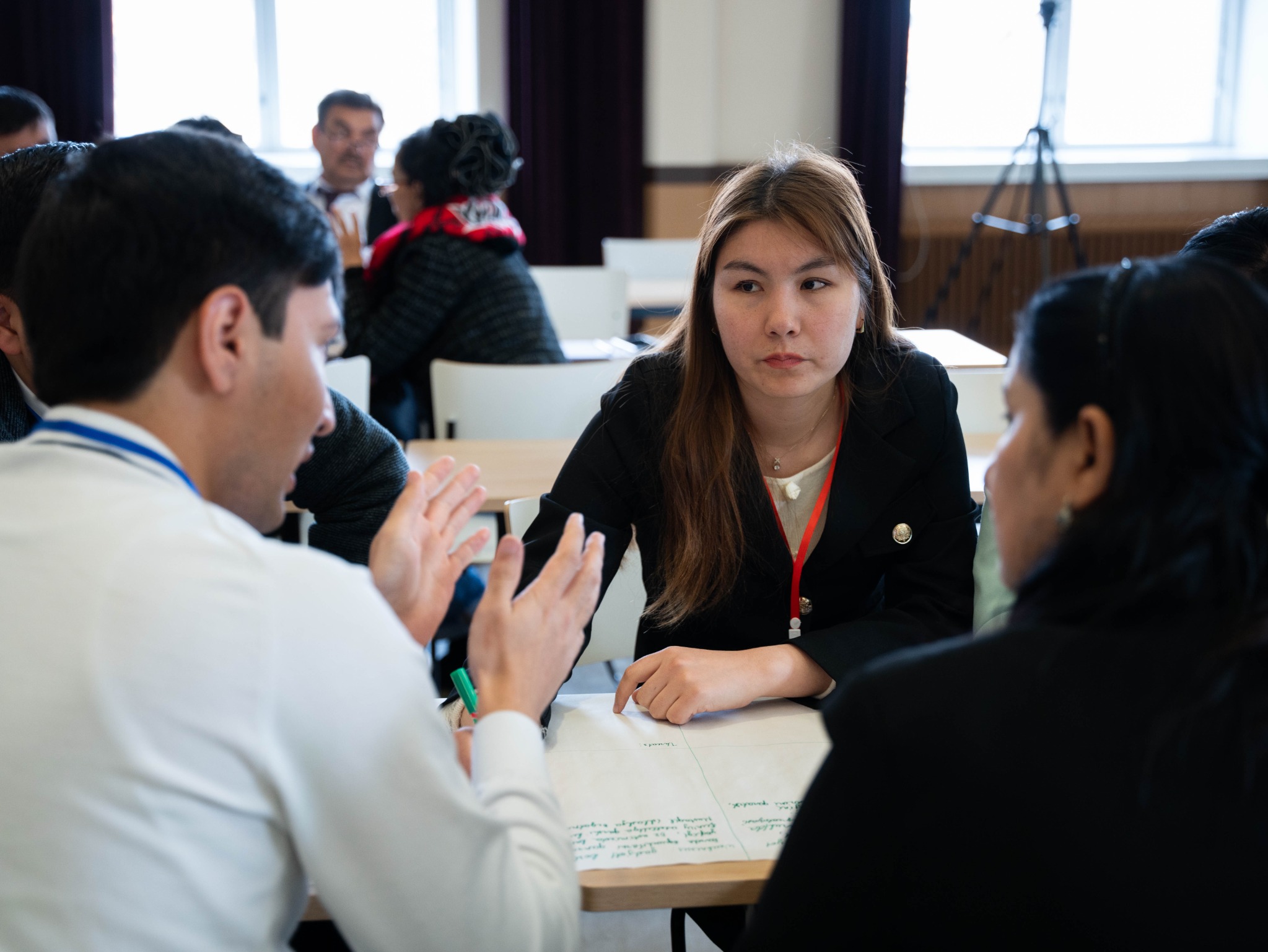
Education systems make choices within their own histories, languages, institutions, resources and expectations. PEDU makes those differences visible so participants can compare responsibly and decide for themselves.
Why PEDU
A useful programme must understand both sides of the encounter: the Finnish setting and the participants’ own educational reality.
We learn about the participants’ country, institution, education system, priorities and constraints before shaping the programme. Finnish practice is then offered through a comparative lens.
Terms such as autonomy, inclusion, assessment, agency and support can carry different meanings across systems. We explain what they mean in Finland and invite delegates to map how the same ideas work at home.
When requested and feasible, PEDU combines interpretation with educational mediation. The aim is to carry contextual and implicit meanings—not simply replace one word with another.
Programmes combine expert dialogue, comparison, practical exploration and visits with structured notes, take-away questions and, where appropriate, a capstone or adaptation project.
PEDU draws on research into professional learning, teacher identity, agency, meaning-making and cognitive dissonance during short international visits—and uses those insights to refine its methods.
We examine strengths, tensions and ongoing reforms. We also challenge familiar myths: Finland does use assessment and grades, teachers are not uniformly satisfied, and no education system is free of problems.
What participants do
Clarify the Finnish meaning behind the visible practice.
Examine differences without ranking cultures or systems.
Test ideas through dialogue, observation and practical work.
Decide what to take, change, investigate further—or avoid.
Why Finland
Finland is worth studying because education sits inside a wider social design: public institutions, professional trust, language policy, geography, welfare, culture, innovation and democratic life.
World Happiness Report
2026Global Innovation Index
2026Corruption Perceptions Index
2025World Press Freedom Index
2026Rankings are reference points, not proof of causality, perfection or educational superiority.
Finland’s education system, teacher preparation, facilities and learning environments have been studied internationally for decades. In PISA 2025, Finnish students remained above the OECD average in science, mathematics and reading, while the country openly confronted its longer-term decline.
OECD data show 660 annual compulsory instruction hours in Finnish primary education, compared with an OECD average of 804; lower secondary figures are 817 and 909. This does not prove that fewer hours cause stronger learning, but it makes the organisation of time, support and responsibility worth investigating.
Finland offers a perspective outside both Anglophone policy centres and high-intensity East Asian examination systems. It is a northern, sparsely populated and relatively young state whose education is shaped by Nordic welfare institutions, local autonomy and its own language environment.
Finnish school concepts, learning solutions and professional expertise operate internationally. Education Finland, coordinated by the Finnish National Agency for Education, exists specifically to bring Finnish educational know-how to global settings—while recognising that a system cannot simply be exported intact.
English is not a national language of Finland—Finnish and Swedish are—yet Finnish higher education offers more than 600 English-taught bachelor’s and master’s programmes. This creates a valuable setting for examining English-medium instruction, multilingual participation and European language policy.
Media freedom, low perceived public-sector corruption, innovation capacity, trust, working life, nature and everyday culture all shape what education can do. Studying Finland therefore means looking beyond schools to the society in which they function.
A whole-system learning environment
PEDU can connect educational questions with universities, schools, workplaces, museums, libraries, innovation environments, nature and public life. The goal is not admiration. It is a more realistic explanation of how practices become possible—and where their limits appear.
Current reference points used on this page. Rankings and comparative indicators are dated so that they can be read in context.
Tell us about your institution, participants and the question that should guide the programme.
Start with the PEDU NavigatorOur Finland Network
PEDU draws its expertise from practitioners and specialists working across Finnish education: teachers and principals in Finnish schools, experts working at JAMK University of Applied Sciences and the University of Jyväskylä, and independent experts and authors. Contributors are selected for each programme and participate in their individual professional capacity unless explicitly stated otherwise.